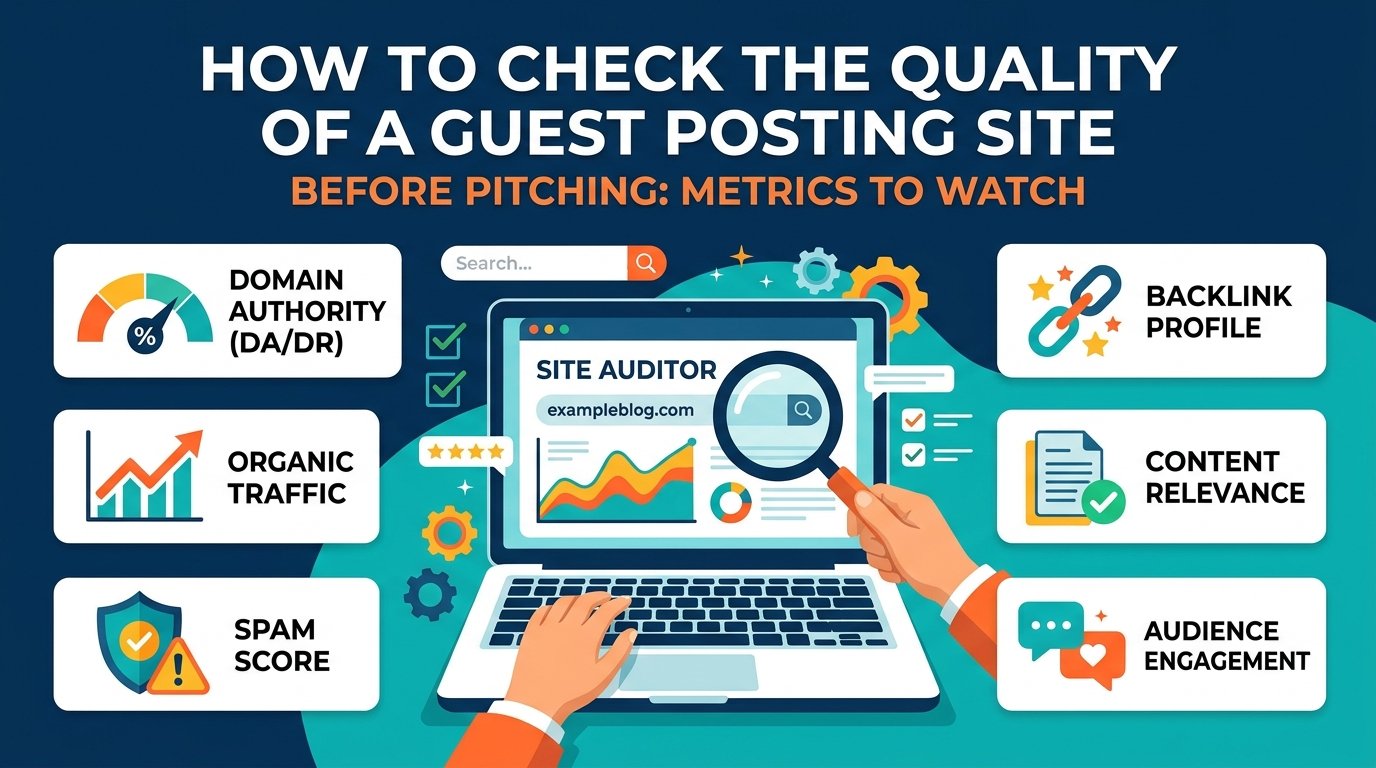


To check the quality of a guest posting site, read its recent articles, look for a real editor and real readers, count its outbound links, and confirm it labels paid links correctly. Authority scores like DR and DA are a tie-breaker, not the verdict. This guide gives you 10 checks and a 20-point scorecard you can run in about ten minutes before you send a pitch. New to the topic? Start with our guide on what a guest post is. To judge a single link rather than the whole site, see what makes a good backlink.
A bad site wastes more than your time. Links from sites that exist to sell links can be treated as link spam, and a good article placed on a site nobody reads earns nothing. Checking first keeps your best ideas for places worth publishing.
What makes a guest posting site “good”?
A good guest posting site has three things: readers who match your customers, an editorial process that keeps the content useful, and links that look earned rather than sold in bulk. A high Domain Rating (DR) or Domain Authority (DA) does not guarantee any of them. Those scores come from Ahrefs and Moz, not from Google, and they can be high on a site with no real audience.
The 10-point scorecard at a glance
Score each check 0 (clear problem), 1 (unsure) or 2 (strong). The maximum is 20. This scoring is our own working rule to compare sites quickly. It is not a Google metric.
| # | Check | Strong (2) | Problem (0) | Where to look |
|---|---|---|---|---|
| 1 | Topic fit | Your subject sits naturally among its posts | Posts on every subject | Last 5 to 10 articles |
| 2 | Editorial standards | Guidelines, named authors, edited writing | No guidelines, anonymous posts | Write-for-us page, bylines |
| 3 | Content quality | Useful, specific, recent posts | Thin, generic, outdated | Blog archive |
| 4 | Outbound links | A few relevant links per post | Many commercial links to unrelated sites | Any 5 posts |
| 5 | Paid-link policy | Sponsored posts are labeled or qualified | Paid links presented as natural | Policy page, page source |
| 6 | Search visibility | Indexed and found by its own name | Few or no pages in Google | site: search, brand search |
| 7 | Audience and traffic | Steady trend, right country | Spikes, crashes, wrong country | Ahrefs or Semrush |
| 8 | DR and DA | Reasonable for its age and topic | Inflated with no traffic | Tool of your choice |
| 9 | Site trust | Real About page, contact details, HTTPS | Hidden owner, broken pages | About, Contact, footer |
| 10 | Terms and placement | Clear price or process, link stays live | Vague terms, links removed later | Email, contributor terms |
Want to skip the vetting? Our guest posts page lists sites we have already checked for traffic, outbound links and real editorial content, with a free replacement for 6 months.
The 10 checks
1. Topic fit
Open the last five to ten articles. Would yours look natural beside them? A dental clinic’s article about oral health belongs on a health or family blog. It does not belong on a site that publishes crypto, casinos and carpet cleaning in the same week. If your topic would look out of place to a reader, it will look out of place to a search engine too.
2. Editorial standards
Look for a write-for-us page with real guidelines: word count, topic rules, a note about originality. Check that posts have named authors with short bios, and that the writing reads like someone edited it. A site that accepts anything within a day and asks for nothing is rarely run by an editor. If you are still hunting for candidates, our guide to Google search operators for write-for-us pages shows how to find them.
3. Content quality
Read two or three full posts, not just titles. Are they specific, with examples and a point of view? Or generic paragraphs that could sit on any site? Check the dates. A site that posts steadily is alive. A site that published 40 articles in one week and then went quiet may have been built for a single purpose.
4. Outbound links
Pick five posts and note where each one links. A healthy post links to a few relevant sources. Be careful when every post carries links to unrelated businesses, especially with exact-match commercial anchor text. That pattern is what link sellers leave behind.
5. Paid-link policy
This is the check most guides skip. Google’s spam policies say that buying or selling links to pass ranking credit violates them, while paid links are fine when qualified with the nofollow or sponsored attribute. They also name guest posts that carry keyword-optimized, ranking-passing links as link spam. You can read the details in Google’s spam policies and how to qualify outbound links.
In practice: if a site sells posts, ask how it labels paid links. A site that is open about using rel="sponsored" is playing by the rules. A site that promises “powerful dofollow links for a fee” is selling exactly what Google warns about. For the full process of getting published the safe way, see our guest posting outreach guide. Our guide to types of backlinks explains each label.
6. Search visibility
Type site:theirdomain.com into Google. You should see a healthy number of pages. Then search the site’s brand name. A real site usually appears for its own name. A site that is barely indexed, or does not show up for its own name, deserves suspicion. Google’s spam policies also cover sites that host third-party content mainly to borrow ranking strength, so a site full of unrelated sponsored posts is a poor bet.
7. Audience and traffic
Traffic matters because a guest post is meant to be read. Look at the two-year trend in Ahrefs or Semrush, where the visitors live, and whether many pages or only one or two bring the readers. We cover this in detail in how to check if a guest post site has real traffic. Treat estimates as estimates: tools are approximations, and a small niche blog with modest, steady traffic can be better than a large site with a random audience.
8. DR and DA
Use them last. DR and DA are third-party scores that help you compare sites at a glance. A site with a high score and a collapsing traffic line is a warning, not a bargain. A modest score on a focused, active site is often a better home for your article.
9. Site trust
Check the basics a visitor would check. Is there an About page that names a person or company? Is there a working contact page? Does the site load over HTTPS, without pop-ups covering the content? A site that hides who runs it gives you no one to hold responsible if something goes wrong.
10. Terms and placement
Before you agree to anything, ask in writing: will the link stay live, what happens if the post is removed, and is it labeled as sponsored? For a free contributor post, read the contributor terms. Vague answers are an answer. Once a site passes, the next job is the pitch itself. Here is how to write a guest post pitch email that editors answer.
Red flags that mean skip the site
- It has no visible editor or contributor guidelines, and accepts any topic.
- Almost every post carries commercial links to unrelated industries.
- It advertises “dofollow links” for sale.
- It barely appears in Google, even for its own name.
- The traffic line spikes and crashes, or the audience is in a country the site never writes about.
- The owner will not share any proof of traffic.
- The same article format repeats across many authors.
Worked example: a dental clinic in Austin
A family dental clinic in Austin, Texas wants one guest post to reach local parents. It shortlists two sites. Both are hypothetical and used only to show the scoring.
| Check | Site A: a parenting blog in Texas | Site B: a general “write for us” blog |
|---|---|---|
| 1. Topic fit | 2 (family health fits) | 0 (anything goes) |
| 2. Editorial standards | 2 (guidelines, named editor) | 0 (none) |
| 3. Content quality | 2 | 1 |
| 4. Outbound links | 2 (a few relevant links) | 0 (many unrelated links) |
| 5. Paid-link policy | 1 (not stated, asks to confirm) | 0 (sells dofollow links) |
| 6. Search visibility | 2 | 1 |
| 7. Audience and traffic | 1 (modest, steady, mostly US) | 0 (spiky, mixed countries) |
| 8. DR and DA | 1 (modest) | 2 (high) |
| 9. Site trust | 2 | 1 |
| 10. Terms and placement | 1 | 0 |
| Total | 16 of 20 | 5 of 20 |
Site B has the stronger authority score and still loses by a wide margin. Site A is the one worth a tailored pitch, with a question about how paid links are labeled.
What to do with the score
- 16 to 20: worth a tailored pitch.
- 11 to 15: look closer. Fix the unsure checks by reading more posts or asking the owner.
- Below 11: skip it. A better site is likely available.
If a site scores 2 on topic fit and 0 on paid-link policy, the 0 decides it. Treat paid-link and editorial problems as deal breakers, not points to average away. For a clean starting audit of your own site first, use our SEO audit checklist before link building.
FAQs
What is the most important metric for a guest posting site?
No single metric decides it. Topic fit and real readers come first, followed by clean outbound links and honest paid-link labeling. DR and DA are useful for comparing sites but should not be the deciding factor.
Is a high DR or DA enough to guest post on a site?
No. They are third-party scores, not Google metrics, and they can be high on a site with no real audience. Use them as a tie-breaker after you have checked the content, links and traffic.
How do I know if a guest posting site is a link farm?
Look for no editor or guidelines, any topic accepted, many commercial links to unrelated sites, and dofollow links for sale. A site that fails several of these is probably selling links in bulk.
Can I pay for a guest post?
Yes, but Google says paid links should be qualified with rel="sponsored" or rel="nofollow". Paying for a link that passes ranking credit violates its spam policies. Ask the site how it labels paid placements.
How long does it take to check a site?
About ten minutes once you know the steps: five to read posts, and the rest for the search, link and traffic checks.
Should I avoid sites with no traffic data?
Not automatically. New or small sites may show little in a tool. Judge them on the content, editorial standards and audience fit, and ask the owner for proof such as a Search Console screenshot.
Next step
A scorecard saves you from bad sites, but vetting takes time. If you would rather publish on sites that have already been checked for traffic, outbound links and real content, browse our guest posts page.