

The fastest way to find write-for-us pages is to pair your topic with a Google search operator, such as coffee intitle:"write for us". Search operators tell Google exactly where to look, whether that’s the page title, the URL, or the text, so you skip the thousands of pages that only mention guest posting in passing.
This guide covers seven write for us search operators, how to combine them, and what to do with the results. It’s one step in our wider guest posting outreach process, which covers pitching and follow-up.
How search operators work
An operator is a short command you type into the normal Google search box. A few rules apply to all of them:
- No space after the colon.
intitle:"write for us"works.intitle: "write for us"does not. - You can combine them. Most of the useful queries in this guide stack two or three operators.
- Results are a sample, not a full list. Google says operators are bound by indexing and retrieval limits, so they won’t return every matching page.
Google’s help page on refining searches lists quotes, the minus sign, site:, before:, after: and filetype:. Operators like intitle:, inurl: and OR aren’t on that page, but they’re widely used and still work. Treat their results as a strong hint rather than a guarantee.
Quick reference: the 7 operators
| Operator | What it does | Example | Best for |
|---|---|---|---|
" " |
Matches an exact phrase | coffee"write for us" |
Your first, broad search |
intitle: |
Phrase must appear in the page title | coffee intitle:"write for us" |
Dedicated contributor pages |
inurl: |
Text must appear in the URL | coffee inurl:write-for-us |
Common page slugs |
OR and ( ) |
Matches any of several phrases | coffee ("write for us" OR "guest post guidelines") |
Covering wording variations |
- |
Removes results with a word or site | -"guest posting sites list" |
Cutting list farms and marketplaces |
after: |
Pages updated after a date | after:2026-01-01 |
Sites still publishing |
site: |
Results from one domain or a domain ending | site:example.com "guest post" |
Checking one site |
The 7 search operators
1. Quotes for exact phrases
Wrap a phrase in quotes to make Google match it word for word. Without quotes, a search for write for us coffee can return pages that use those words separately.
coffee "write for us"
Try other phrases editors use for the same page: “guest post guidelines”, “become a contributor”, “submit a guest post”, and “contributor guidelines”. Some sites use “write for me” when one person runs the blog.
2. intitle: to find dedicated pages
intitle: limits results to pages with the phrase in the title tag. A page titled “Write for Us” is almost always a real submission page, not a blog post that mentions guest posting once.
coffee intitle:"write for us"
This is usually the highest-quality single search. Expect fewer results than with quotes alone, but a better hit rate.
3. inurl: to match common page slugs
inurl: matches text in the address. Many sites use predictable slugs for contributor pages.
coffee inurl:write-for-us
Other slugs worth trying are inurl:guest-post, inurl:contribute and inurl:contributor-guidelines. Pairing intitle: with inurl: gives a tight result set:
coffee intitle:"write for us" inurl:write-for-us
4. OR and parentheses to search many phrases at once
OR returns pages that match any of the terms. Parentheses keep the group together. The vertical bar | does the same job as OR. Type OR in capitals.
coffee ("write for us" OR "guest post guidelines" OR "become a contributor")
You can group topics too, which helps when your niche goes by several names:
(coffee OR espresso OR "home brewing") intitle:"write for us"
5. The minus sign to remove list farms and noise
A minus sign in front of a word, phrase or site removes those results. This matters because many “write for us” searches are crowded with articles that list hundreds of guest post sites, plus marketplaces selling placements.
coffee intitle:"write for us" -"guest posting sites" -"sites that accept guest posts"
To drop a specific site, use the minus sign with site:, such as -site:pinterest.com. Add exclusions one at a time as you spot repeated noise in your results.
6. after: to find sites that are still active
A write-for-us page that hasn’t been updated in years often belongs to a site that stopped publishing. after: limits results to documents Google sees as updated after a date. before: does the opposite.
coffee intitle:"write for us" after:2026-01-01
The date reflects when Google thinks the page was last updated, not when the site last posted. Always open the blog and check the dates on recent articles.
7. site: to check one site or search inside a domain type
site: restricts results to one domain. Use it to check whether a site you already like accepts guest posts, even if it doesn’t link to a contributor page from its menu.
site:example.com ("guest post" OR "write for us" OR "contributor")
You can also use a domain ending. site:.org "write for us" coffee limits results to .org sites, such as associations. Google’s site: operator guide notes that results aren’t always complete, so a missing result doesn’t prove the page doesn’t exist.
Stack operators into search recipes
Single operators are useful. Combined, they cut most of the noise. Replace [topic] with your niche.
| Goal | Query |
|---|---|
| Dedicated contributor pages | [topic] intitle:"write for us" inurl:write-for-us |
| All common wordings at once | [topic] intitle:("write for us" OR "guest post" OR "contribute") |
| Active sites only | [topic] intitle:"write for us" after:2026-01-01 |
| Without list articles | [topic] "write for us" -"guest posting sites" -"list of" |
| Sites a known guest author has written for | [topic] "[author name]" inurl:author -site:[their own site] |
| Does one site accept guest posts? | site:[domain] ("guest post" OR "write for us") |
Example: an Ohio roofing contractor
This is an illustrative example, not a client case.
A roofing contractor in Columbus, Ohio wants guest posts on home improvement blogs. A plain search for home improvement write for us returns a mix of list articles, marketplaces and old pages.
The contractor narrows it in three steps:
("home improvement" OR roofing OR "home repair") intitle:"write for us"finds dedicated pages across related topics.- Adding
-"guest posting sites" -"list of"strips out the list articles. - Adding
after:2026-01-01keeps sites that Google sees as recently updated.
The result is a short list of real contributor pages in the right niche. That list still needs checking before any pitch goes out.
What to do with your results
A write-for-us page tells you a site accepts contributions. It says nothing about whether real people read it. Before you pitch, check each site’s organic traffic trend, where its visitors come from, and who it links out to. Our guide on how to check if a guest post site has real traffic walks through six quick checks.
Add the sites that pass to a tracker sheet with the URL, the query that found it, and the date. If you would rather skip prospecting altogether, our guest post service only lists sites we have already checked for traffic, topic and outbound links.
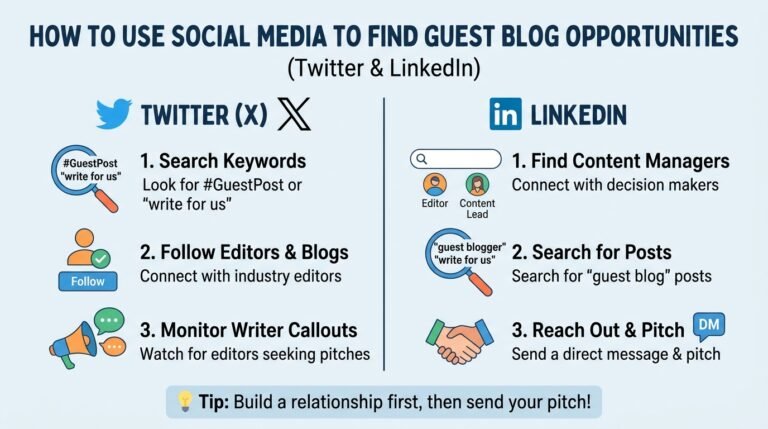
Google is not the only place to look. You can also find guest blog opportunities on Twitter and LinkedIn, where editors post open calls for contributors.
If a site asks for payment, the link should be marked rel=”sponsored” or rel=”nofollow”. Google’s spam policies treat paid links that pass ranking credit as link spam.
Common mistakes
- Adding a space after the colon. The operator stops working and Google treats it as a normal word.
- Stacking too many operators. Five or six filters can return almost nothing. Remove one at a time until results appear.
- Treating a write-for-us page as proof of quality. Many link farms publish one. Check traffic first.
- Copying sites from public lists. Everyone else pitches the same sites, and many list entries are stale.
- Running one search and stopping. Try several wordings and slugs. Each turns up different sites.
Frequently asked questions
What is the best search operator for finding guest post sites?
intitle: combined with quotes, such as [topic] intitle:"write for us", gives the best hit rate for a single search. It returns pages built for contributors, not pages that mention guest posting in passing.
Do Google search operators still work?
Yes. Quotes, the minus sign, site:, before:, after: and filetype: are listed on Google’s help page. intitle:, inurl: and OR aren’t listed there but still work in practice. Results are a sample, not a complete list.
Why does my search operator return no results?
The most common cause is a space after the colon. The next most common is stacking too many filters. Check the spelling, remove one operator at a time, and try again.
How do I find sites that accept guest posts without a write-for-us page?
Search for articles by guest authors in your niche, or use site: to check whether a site you like has published outside writers. Many sites accept strong ideas even without advertising for them.
Are sites with write-for-us pages good for SEO?
Not automatically. Some have real readers, and some exist mainly to sell links. Check traffic, topic fit and outbound links before you pitch. Our guide to what a guest post is explains what makes a placement worth it.
How often should I rerun these searches?
Rerun your best recipes every month or two, and keep the after: date recent. New sites launch contributor pages all the time, and old ones stop accepting posts. Log the date of each search in your tracker so you know what is new.
Build your list, then pitch
Start with one recipe from the table above, run it with three or four wordings, and filter the results. Ten well-chosen sites beat a hundred unchecked ones.
If you want sites that have already been checked for real traffic, see how our guest posts work.