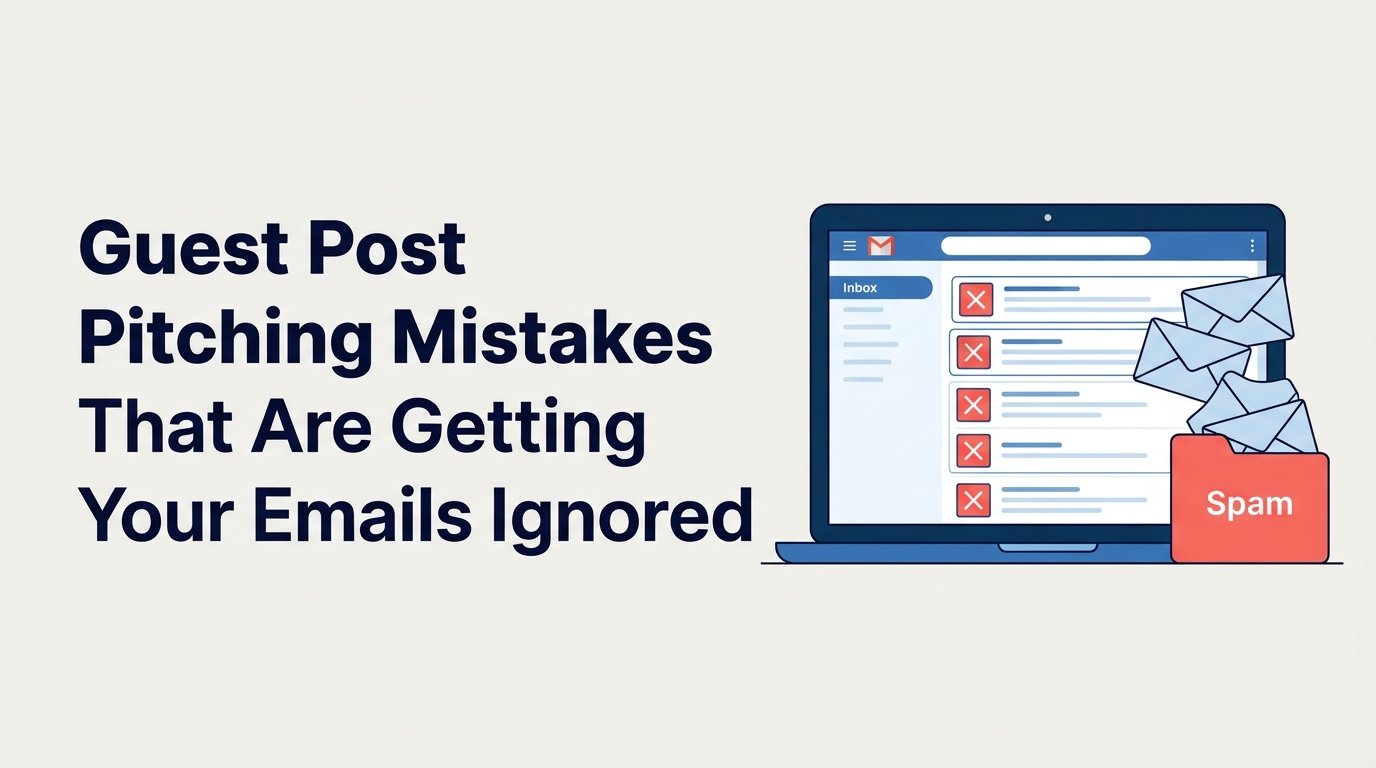


Most guest post pitches are ignored because the email is about the sender, not the editor’s readers. Editors decide in seconds, and the same five mistakes make them close the email: pitching a site you have not read, leading with your company, offering vague ideas, asking for a link too early, and sending sloppy details with no clear ask. If you are new to the topic, start with our guide on what a guest post is.
One blog owner counted the pitches that reached his inbox between January and March 2019. Mangools reported that 168 of 230 pitches, about 73%, went straight to the trash. The sample is older, but the pattern still holds: editors are not rejecting your idea, they are rejecting an email that gave them no reason to read it.
This guide walks through each mistake, shows what the editor sees, and gives a fix you can use today. If you want ready-made email templates, use our guide on how to write a guest post pitch email. This article is for working out why yours is not getting answered.
What an editor sees in the first few seconds
An editor opens your email with three quiet questions. Is this for my readers? Does this person look careful and real? Will saying yes create extra work for me?
Every mistake below fails at least one of those questions. Keep them in mind and the fixes make sense.
Mistake 1: Pitching a site you have not read
The fastest way to get ignored is to send an idea that could have gone to any website. Editors can tell. The email mentions no article, no topic they cover and no gap on their site. A nursing course offered to an SEO blog is an extreme example, but the quieter version is just as common: a “marketing” idea sent to a site that only publishes product-led growth stories.
What the editor thinks: “This person did not look at my site.”
The fix: spend ten minutes before you write a word.
- Read the last five to ten articles. Would your idea fit beside them?
- Search
site:theirdomain.com your topicin Google to confirm they have not covered it. - Read the contributor guidelines if there are any, and follow them exactly.
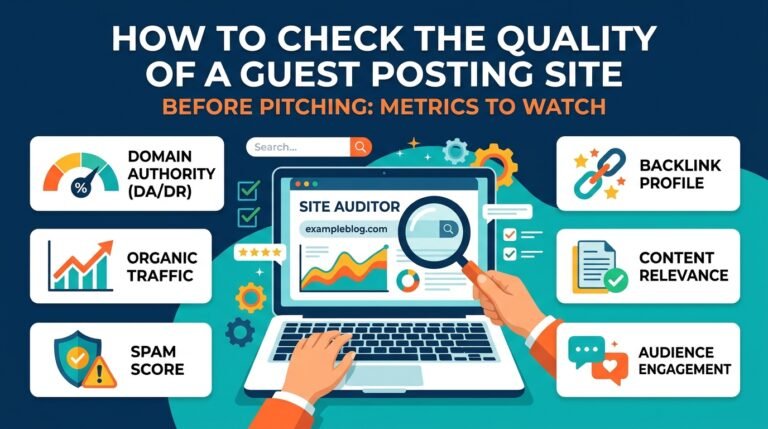
- Check that the site has real readers and real editorial standards. Our guides on checking guest post site quality and checking for real traffic show what to look for.
Before: “I love your blog and would like to write a guest post for you.”
After: “Your article on pricing a service call mentioned warranty add-ons but not seasonal tune-ups. I have an idea that fills that gap.”
The second version proves you read something. That one detail answers the editor’s first question.
Mistake 2: Leading with yourself and your company
Many pitches open with who the sender works for and what the company sells. It feels like honesty. To an editor, it reads as an ad that wants a place to live.
Guest posts exist to help the host site’s readers. A pitch that starts with your business tells the editor you care about your exposure first.
What the editor thinks: “This is a promotion, not an article.”
The fix: lead with the reader’s problem and put yourself in one short line near the end.
- Open with the specific reader and what they will learn.
- Give your role in one sentence, and only where it proves you know the topic.
- Link to one or two published pieces with your name on them, not a company page.
Before: “I’m the marketing manager at BrightAir HVAC, the top-rated heating company in Tampa.”
After: “Your homeowner readers often ask when to service an air conditioner. Here is an idea on what to check before the first hot week. I run service for a Tampa HVAC company, and a recent article of mine is linked below.”
The business is still there. It just no longer comes first.
Mistake 3: Vague ideas and no proof you can write
“High-quality, SEO-friendly content” says nothing an editor can check. Neither does “a guest post about marketing.” Without a specific topic and a sample, the editor has to guess whether you can deliver, and busy people do not guess.
This is also where overpromising shows up. Telling an editor your article will be unique and free of plagiarism tells them nothing about whether it will be useful. Editors expect that much.
What the editor thinks: “I would have to do all the work to find out if this is good.”
The fix: make the decision easy.
- Offer two or three specific ideas, one sentence each, written around what the reader gains.
- Link to a published sample with your byline. If you have none, link to a strong piece on your own blog.
- Show a point of view or a number from your own experience rather than a general tip.
- Do not send a finished article unless the guidelines ask for it. Editors usually prefer to approve the idea first.
Before: “I can write a high-quality article on any topic you choose.”
After: “Two ideas: 1) How to read an AC repair estimate line by line. 2) Five noises that mean call a technician now, and three that do not.”
Specific beats polished every time.
Mistake 4: Asking for the link, anchor or a swap first
This is the mistake that hurts you with search engines as well as editors. A pitch that asks for a dofollow link, names an exact keyword anchor, or offers “I’ll link to you if you link to me” tells the editor the article exists for the link.
It also runs into Google’s rules. Google’s spam policies list buying or selling links for ranking purposes as link spam, including exchanging money for links or for posts that contain links, and excessive link exchanges. They also list links with optimized anchor text in guest posts as an example. The same policy says paid or sponsored links are not a violation when they are qualified with a rel="nofollow" or rel="sponsored" value.
What the editor thinks: “This is a link request wearing an article costume.”
The fix:
- Leave links, anchors and prices out of the first email. Pitch the idea.
- When you do talk about your link, make it natural and useful to the reader. Brand or descriptive anchors read better than exact-match keywords.
- If money or goods change hands, say so and agree that the link will be marked
rel="sponsored"orrel="nofollow". - Do not offer link swaps as a tactic.
If you would rather not negotiate with each site yourself, you can compare sites and prices in one place on our guest post service page and choose how the link is labeled at checkout. For a full explanation of the policy, read our guide on free vs. paid guest posting.
Before: “Please publish with a dofollow link to our AC repair page using the anchor ‘best AC repair Tampa’.”
After: (Nothing about links in the first email. The ask is about the idea.)
Mistake 5: Sloppy details and an unclear ask
Typos happen, and most editors forgive one. What they do not forgive is a pattern: random capitalization, mixed fonts, a wrong name, a dead sample link, or an email sent to a general inbox when the site lists a contributor address.
The other half of this mistake is the ending. An email that finishes with “let me know” gives the editor no easy next step, and an email that is never answered is the usual result.
What the editor thinks: “If the pitch is this careless, the article will take hours to fix.”
The fix:
- Read the pitch out loud once, or print it. Fix names, dates and links.
- Use the contact or form the site asks for, and address a real person.
- Check that every sample link works and shows your name.
- End with one clear question, such as “Would either idea fit your editorial plan? I can send a short outline first.”
- If you hear nothing, send one follow-up after four to seven days with something new, then stop.
Quick check before you send
| Question | Yes means |
|---|---|
| Did I name a real article and a specific detail from it? | The site fit is clear |
| Does the email start with the reader, not my company? | It reads as editorial, not promotional |
| Are there two or three specific ideas and one sample link? | The editor can decide fast |
| Is there nothing about links, anchors or swaps? | It follows Google’s link rules |
| Is there one clear question at the end? | The next step is easy |
Working through this list once can save you a whole outreach round. For the full process of finding sites and tracking replies, see our guest posting outreach guide.
Frequently asked questions
Why are my guest post pitches being ignored?
Usually because the email is generic, leads with your company, or does not give the editor a specific idea and an easy next step. Fixing those three things changes most results.
How long should a guest post pitch be?
A few short paragraphs. If an editor has to scroll on a phone to find your question, trim it.
Should I follow up if I get no reply?
Yes, once, four to seven days later, with a new idea or a useful addition. More than that reads as pressure.
Should I send the full article with my first email?
Usually not. Offer an outline or ask whether they want the draft, unless the guidelines ask for a full submission.
Can I ask for a dofollow link in my pitch?
Do not lead with it. Editors approve ideas that help readers. If you are paying, the link should carry rel="sponsored" or rel="nofollow".
What if the site has no write-for-us page?
Check whether it publishes outside authors in its recent articles. If it does, send one specific idea and say how it fits their coverage.
Pitch less, and make each email count
Ten tailored pitches beat fifty copies. Fix these five mistakes, send a smaller number of better emails, and track which topics get replies. A pitch only helps if the page your link supports is ready to rank, so run through our SEO audit checklist before link building first. If you would rather skip the pitching, our team can handle site selection and placement. See our guest posts page for how it works.