

A guest post pitch email is a short message that offers an editor one specific article, shows it fits their readers, and makes it easy to reply. The pitches that get approved name a real article on the site, offer two or three focused topics, and end with one clear question.
This guide shows the structure, four templates for different situations, a worked example for a roofing company, and a checklist to run before you hit send. If you want the bigger picture first, start with what a guest post is, then come back here to write the email.
What editors decide in the first few seconds
An editor opens your email with three questions in mind. Is this relevant to my readers? Does this person look careful and real? Will saying yes create extra work for me?
Every part of a good pitch answers one of those questions. A specific reference to their article answers the first. A short, clean email with a real sample answers the second. Two ready topics and an offer to send an outline answer the third.
A pitch that could have been sent to any site fails all three, which is why generic templates get ignored.
Do three checks before you write a word
Most rejected pitches fail before the first sentence. Run these checks first.
- Check that the site is worth pitching. Look for steady organic traffic, readers in the right country and real articles with named authors. Our guide to checking that a guest post site has real traffic walks through the numbers.
- Check that your topic is not already covered. Search the site with
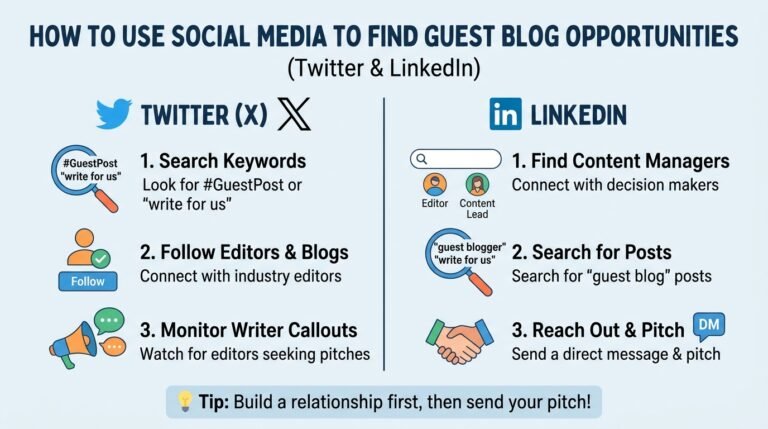
site:example.com your topicin Google, then read the top two or three results. Pitch an angle they have not published. - Check the rules. If there is a contributor page, follow it exactly, including the email address or form it asks for. If you need to find sites that accept outside writers, use Google search operators to find write-for-us pages. You can also find guest blog opportunities on Twitter and LinkedIn.
For the rest of the process, from building a prospect list to tracking results, see the full guest posting outreach process. This article stays on the email itself.
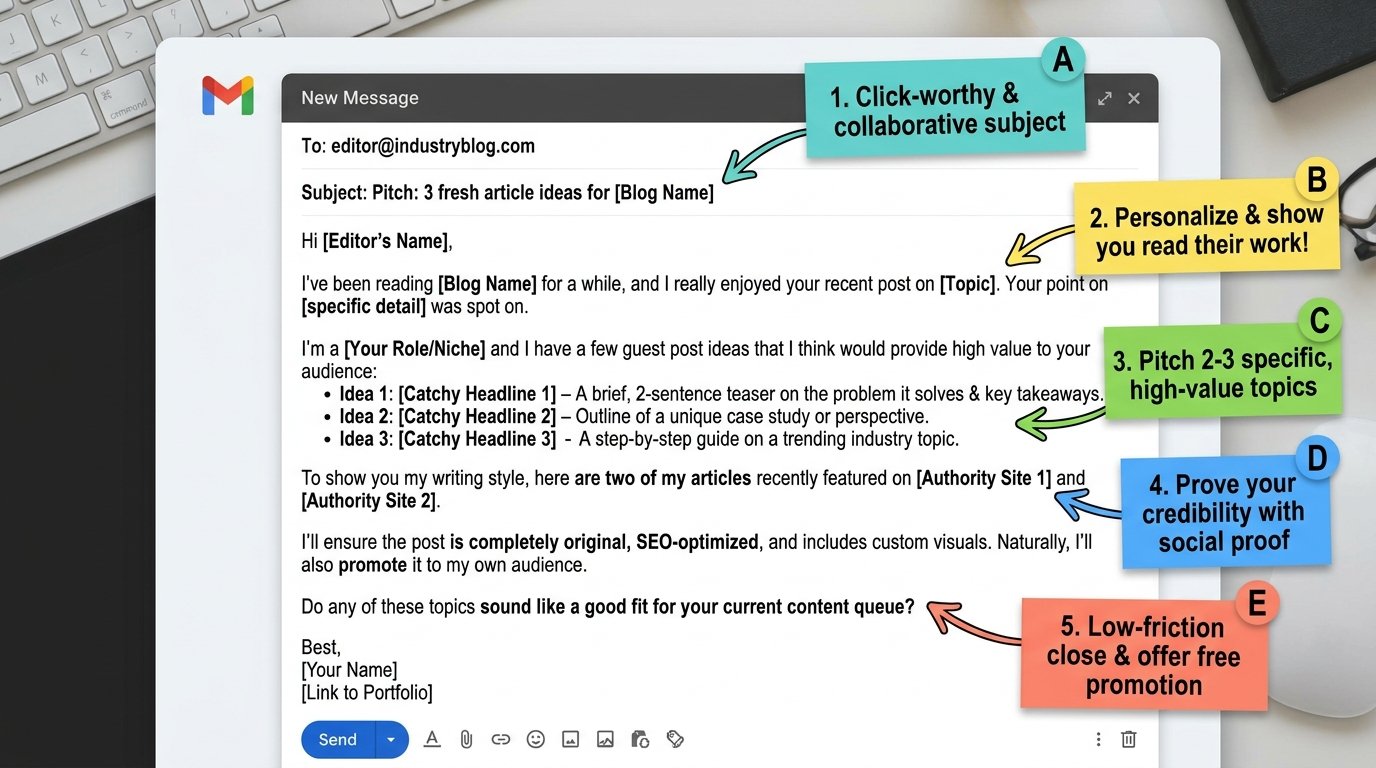
The five parts of a pitch that gets a reply
- A specific subject line. Name the site’s topic or your article idea, not the fact that you want a guest post.
- One line that proves you read the site. Name a real article and say what was useful in it. Skip general praise like “love your blog.”
- Two or three topic ideas. One sentence each, written around what the reader gains. Each should fit what the site already covers and fill a gap it has not.
- One line about you. Your role and one relevant credential or published piece. Link to work on a site your reader would recognize, not just your own blog.
- One clear question. Ask which idea fits their plan, or whether you can send an outline. A question gets an answer; a statement does not.
Keep the whole email short enough to read on a phone without much scrolling. There is no official length rule, but a few short paragraphs is a practical target.
Subject lines that fit the email
A good subject line is specific and honest. These are starting points, and no open-rate data backs them, so test two or three on your own list:
- Two article ideas for [Site Name]’s [category] readers
- A reader question your [article title] does not answer
- Outline ready: [working title]
- [Topic] idea for [Site Name]
Avoid “Guest post request,” stacked exclamation marks, all caps, and a fake “Re:” that pretends to continue a thread. Editors see these daily, and the fake reply damages trust before they read a word.
Which template to use
| Your situation | Use | What the email asks |
|---|---|---|
| The site has contributor guidelines | Template 1 | Which of two ideas fits, following their process |
| No guest page, but it publishes outside writers | Template 2 | Whether they are open to one specific idea |
| You have an outline or draft ready | Template 3 | Permission to send it |
| You are willing to pay for a placement | Template 4 | Rates, requirements and how they label sponsored posts |
Four guest post pitch email templates
Replace everything in brackets. If you cannot fill a bracket with something true and specific, delete that line instead of guessing.
Template 1: The site has contributor guidelines
Subject: Two article ideas for [Site Name]'s [category] readers

Hi [First name],

I read “[Article title]” and the point about [specific detail] matched what I see with [type of customer] every week. I also noticed [Site Name] has not covered [gap topic] yet.

Two ideas, following your contributor guidelines:

1. [Working title]: [one sentence on what the reader learns]
2. [Working title]: [one sentence on what the reader learns]

I'm [Name], [role] at [business], where I [one line of relevant experience]. A recent piece of mine: [link].

Would either idea fit your editorial plan? I can send a short outline first.

Thanks,
[Name]
[Website or LinkedIn]
Template 2: No guest page, but outside writers appear on the site
Subject: [Topic] idea for [Site Name]

Hi [First name],

I noticed [Site Name] publishes pieces from outside contributors, such as “[Contributor article title].” If I have that wrong, my apologies.

Your readers searching for [topic] currently find [what the site offers now]. A practical piece on [specific angle] would fill the gap: [one sentence on what the reader learns and does].

I'm [Name], [role] at [business]. Here is a recent article I wrote: [link].

Would this be of interest? I'm happy to send an outline.

[Name]
Template 3: You have an outline ready
Subject: Outline ready: [Working title]

Hi [First name],

I've outlined an article for [Site Name] on [topic] for your readers who [reader situation].

It covers:
- [Section 1: reader outcome]
- [Section 2: reader outcome]
- [Section 3: reader outcome]

The full draft would run about [length] words and follow your style guide. Could I send the outline, or would you rather see the draft?

Thanks,
[Name]
[Link to a published sample]
Template 4: You are willing to pay for a placement
Subject: Sponsored article inquiry for [Site Name]

Hi [First name],

I'm [Name] from [business]. We'd like to publish a sponsored article on [Site Name] about [topic] for your [audience] readers.

Could you share your rates, editorial requirements and how you label sponsored posts? We understand paid links should carry rel="sponsored" or rel="nofollow", and we're glad to follow your editorial standards and let you review the draft.

Thanks,
[Name]
[Website]
Negotiating with one site at a time takes weeks. If you would rather compare prices and metrics in one place, you can pick a site in our guest post marketplace and choose a sponsored or standard link at checkout.
Worked example: a roofing company, before and after
Say you run a roofing company in Denver. You want readers of a regional home-maintenance blog to find your guide to hail damage inspections. The names below are made up for illustration.
The weak version:
Subject: Guest post request

Hi, I run a roofing company and would like to write a guest post for your site. We offer high-quality, SEO-friendly content. Please send your guidelines and prices.
This fails for three reasons. It says nothing about the site’s readers, it leads with what the sender wants, and it hands the editor the job of figuring out what to do next.
The stronger version:
Subject: What to check on your roof after a hailstorm

Hi Dana,

Your piece on cleaning gutters before winter had a useful tip about checking downspout spacing. I noticed the blog has covered gutters and siding but not roofs after storm season.

Two ideas for your homeowner readers:

1. How to spot hail damage from the ground, before you call anyone
2. Five questions to ask before you sign a roof repair estimate

I own a roofing company in Denver and have inspected storm-damaged roofs for [number] years. A recent piece of mine: [link to a published article].

Would either idea fit your editorial plan? I can send an outline first.

Thanks,
Sam Rivera
The stronger email names a real article, fills a visible gap, offers two usable topics, and puts a clear question at the end. It also does not demand a link, an anchor or a price in the first message.
How to follow up
Silence is normal. Send one follow-up four to seven days after the first email, and add something new instead of repeating yourself.
Subject: Re: [Original subject]

Hi [First name],

A quick follow-up on my note about [topic]. In case a different angle fits better: [third idea, one sentence].

If the timing is not right, no problem at all.

[Name]
If there is still no answer, stop. If an editor says no, thank them and ask whether a different topic would be welcome later. Our outreach guide covers tracking replies and automating follow-ups when you pitch many sites.
Why pitches get rejected
- The pitch is generic. Nothing in it could not have been sent to ten other sites.
- The topic is already on the site. A two-minute search would have caught it.
- The idea is an ad. Topics that exist only to promote your service get declined, even from polite senders.
- The sender asks for the link first. Anchor text, link count and pricing belong later in the conversation, if at all.
- The guidelines were ignored. Wrong format, wrong email address or a topic the site says it does not accept.
- The ask is unclear. The editor cannot tell whether you are offering a topic, a draft or a paid post.
- The claims cannot be checked. Vague phrases like “high-quality, SEO-friendly” say nothing an editor can verify.
Paid links and the pitch
Google does not ban paid placements, but it treats buying or selling links that pass ranking credit as link spam. Its spam policies list exchanging money, goods or services for links, excessive link exchanges, and optimized anchor text in guest posts among the examples. Paid or sponsored links are fine when they carry a rel="nofollow" or rel="sponsored" value, and Google’s guide to qualifying outbound links prefers sponsored for paid placements.
Three rules follow for your pitch:
- If money or goods change hands, say so and agree on a sponsored or nofollow link.
- Do not offer “I’ll link to you if you link to me” swaps as a tactic.
- Leave exact-match anchors out of the first email. Brand or descriptive anchors read naturally and carry less risk.
Pre-send checklist
- The site has real readers in my niche.
- My topic is not already on the site.
- I followed the contributor guidelines or confirmed the site accepts outside writers.
- I wrote to a named person, not a generic inbox.
- The email names a real article and a specific detail from it.
- I offer two or three topics, one sentence each.
- The sample I link to is a published piece I wrote.
- The email ends with one clear question.
- Nothing in it asks for a link, an anchor or a swap.
- I read it once on my phone.
Frequently asked questions
How long should a guest post pitch email be?
A few short paragraphs. There is no official limit, but if an editor has to scroll on a phone to find your question, trim it.
Should I send the full article with the first email?
Usually not. Offer an outline or the draft and let the editor choose, unless the contributor guidelines ask for a full submission.
How many topics should I pitch?
Two or three. One feels like a take-it-or-leave-it; more than three looks unfocused.
Can I ask for a dofollow link in the pitch?
Do not lead with it. Editors approve pitches for the reader benefit. If you are paying, the link should be marked sponsored or nofollow.
How many times should I follow up?
Once, after four to seven days, with a new idea or a useful addition. A second follow-up is a judgment call; more than that reads as pressure.
What if the site has no write-for-us page?
Check whether it publishes outside authors in its recent articles. If it does, use Template 2 and propose one specific idea.
Pitch with confidence, then place the link where it counts
A pitch only works if the page your link will support is ready to rank. Run through our SEO audit checklist before building links first. If you would rather skip the pitching and have sites checked and placements handled for you, see our guest post service.