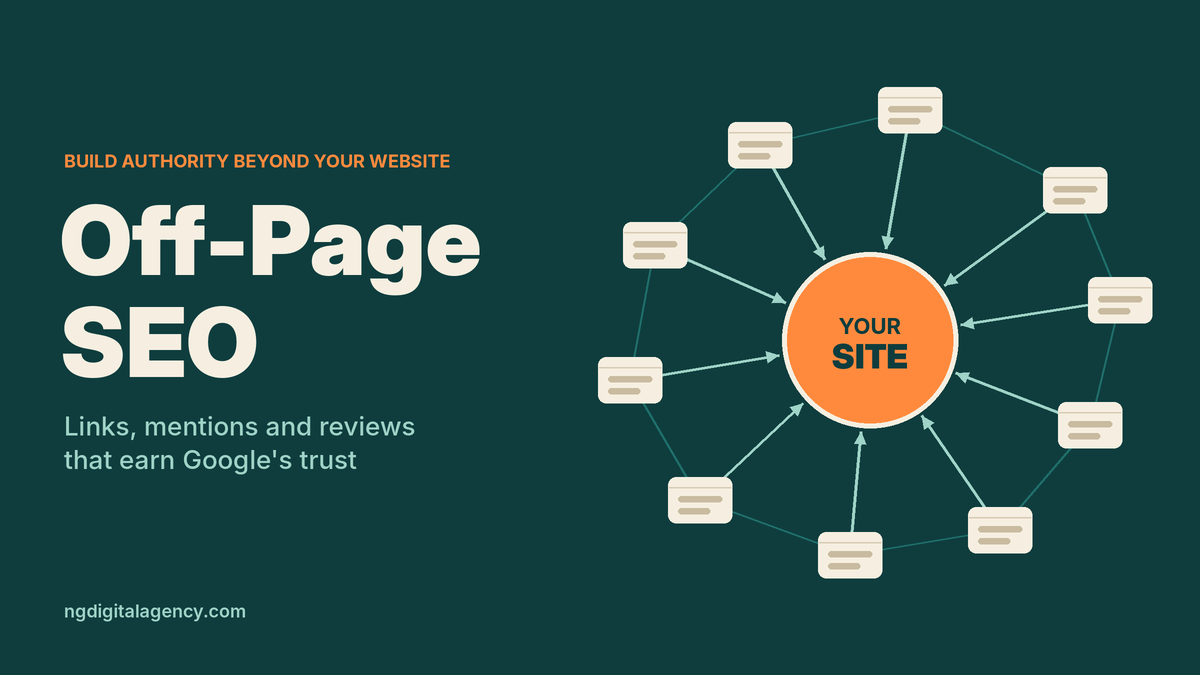


Off-page SEO is everything that happens outside your own website that helps search engines trust it: mainly links from other sites, but also mentions of your business, reviews and local listings. If on-page SEO makes a page the right answer, off-page SEO is how the rest of the web vouches for it.
This guide covers how Google actually uses off-site signals, which tactics are worth your time, and which ones can quietly hurt your site. If you’re new to the topic, start with what SEO is.
On-page vs off-page SEO
| On-page SEO | Off-page SEO | |
|---|---|---|
| Where the work happens | On your own pages | On other websites and platforms |
| Main question | Is this page the best answer? | Does the rest of the web trust and recommend you? |
| Examples | Content, titles, headings, internal links | Backlinks, brand mentions, reviews, local citations, PR |
| Control | Full | Partial: you earn it, others decide |
| Speed | Changes are quick to make | Builds slowly over months |
The order matters. Links send more value to a page that already answers the search well and loads properly. If your site has indexing or speed problems, run through our SEO audit checklist first.
How Google uses off-page signals
Links
Links are the biggest off-page signal, and Google says so openly. Its guide to ranking systems describes link analysis systems, including PageRank, that use how pages link to each other to understand what pages are about and which might be most helpful. PageRank is still one of Google’s core systems.
Google’s explanation of how results are ranked puts it simply: when other prominent websites link to or reference content, that’s generally a good sign the information is trustworthy. (We cover the full ranking process in how SEO works.)
Not all links count the same. One link from a respected site in your industry is worth far more than dozens from sites nobody reads.
Local prominence: reviews and mentions
For local searches, such as “plumber near me” or the map results, Google ranks businesses on relevance, distance and prominence. Google’s local ranking help page says prominence reflects how well known a business is, including how many websites link to it and its review count and rating. It also says there’s no way to pay for a better local ranking.
What Google doesn’t use
Some numbers you’ll see in SEO tools aren’t Google signals at all:
- Domain Authority (DA), Domain Rating (DR), Trust Flow. These are scores made by SEO tool companies to estimate a site’s link strength. They’re useful for comparing sites, but Google doesn’t use them.
- Social shares and likes. Google’s ranking systems guide doesn’t list social signals. Social media helps indirectly: it gets content in front of people who might link to it or search for your brand.
Off-page SEO tactics, ranked by value and risk
Here’s how common tactics compare for a typical small or mid-size business.
| Tactic | Value | Risk | Effort |
|---|---|---|---|
| Content worth linking to (guides, data, tools) | High | Low | High |
| Digital PR and expert quotes | High | Low | Medium |
| Guest posts on relevant, real sites | Medium to high | Low if done properly; high if done at scale with keyword anchors | Medium |
| Unlinked mentions and broken link outreach | Medium | Low | Low to medium |
| Google Business Profile and local citations | High for local businesses | Low | Low |
| Reviews | High for local businesses | Low (never fake or buy them) | Ongoing |
| Social media and communities | Indirect | Low | Ongoing |
| Mass directories, forum signatures, comment links, link exchanges | Little to none | High | Low |
Create something worth linking to
The most durable links come from content other people want to reference: a clear cost guide for your service area, original survey data, a free calculator, or an expert explainer. A roofing company that publishes “What a Roof Replacement Costs in Denver, by Material” gives local reporters and bloggers something to cite.
Digital PR and expert quotes
Journalists and bloggers regularly look for expert sources. Answering their requests, pitching a local angle, or sharing original data can earn mentions and links on news sites. These links are editorial, which is exactly what Google wants links to be.
Guest posting on relevant sites
A guest post is an article you publish on another site in your field. Done well, it puts your expertise in front of a new audience and earns a relevant link.
Two rules keep it safe. First, the host site should have real readers in your niche; learn how to check if a guest post site has real traffic. Second, if you paid for the post or the link, it should be marked. Google’s guide to qualifying outbound links says paid links should use rel="sponsored" (preferred) or rel="nofollow".
For anchor text, use your brand name, URL or a natural descriptive phrase. Repeating the same exact-match keyword anchor across many posts looks manipulative and leaves an obvious footprint.
If you’d rather not find and vet sites yourself, our guest post service only lists sites checked for real organic traffic, and recommends marking links as sponsored.
Unlinked mentions and broken links
Search for your business name to find articles that mention you without a link, then politely ask the author to add one. Similarly, if a site links to a page that no longer exists and you have a genuinely useful replacement, let them know. Both are low-risk and often welcome.
Local citations and Google Business Profile
For local businesses, a complete Google Business Profile is essential: correct categories, hours, service area, photos and regular updates. Keep your business name, address and phone number consistent on trusted listings such as your industry association, chamber of commerce and major review platforms. Skip mass directory submissions; Google lists low-quality directory links as link spam.
Reviews
Ask happy customers for honest reviews, and reply to all of them, including negative ones. Never buy reviews or offer rewards for positive ones. Reviews matter for local prominence, and they’re what customers read before they call.
Social media and communities
Social posts and community answers (Reddit, Quora, industry groups) won’t pass ranking value directly. Their job is visibility: the more relevant people see your content, the more likely some will link to it or search for you by name. Join conversations to help, not to drop links.
How to judge a link before you chase it
Ask these questions about any site you want a link from: For a longer checklist, see what makes a good backlink.
- Would a real customer read this site? Check that it has steady traffic, not just a high DR.
- Is it about your topic or audience?
- Does it publish real content with named authors, or is every post a thin article with outbound links?
- Would you be happy if a customer clicked through from it?
If the honest answer to most of these is no, the link isn’t worth having, at any price.
Link spam: what Google says to avoid
Google’s spam policies list link practices that can get a site demoted. The ones small businesses run into most often:
- Buying or selling links that pass ranking credit, including exchanging goods or services for links
- Excessive link exchanges (“link to me and I’ll link to you”)
- Using automated programs or services to create links
- Advertorials with paid links that pass ranking credit
- Low-quality directory or bookmark site links
- Forum comments with optimized links in the post or signature
- Links in widgets, footers or templates spread across many sites
If a link-building offer sounds cheap, fast and guaranteed, it usually falls into one of these.
Example: an HVAC company’s first six months
Here’s an illustrative plan for a heating and cooling company in Columbus, Ohio, after it has already fixed its website.
- Month 1: local foundation. Completes its Google Business Profile, fixes inconsistent addresses on a few listings, and joins the local contractors’ association, which lists members with links.
- Month 2: reviews. Adds a short review request to its post-job email. Replies to every review.
- Month 3: linkable content. Publishes “What a New Furnace Costs in Columbus” with real price ranges from its own jobs.
- Month 4: PR. Pitches that guide to a local news site ahead of winter. A reporter quotes the owner and links to it.
- Month 5: guest posts. Writes two guest posts for real home-improvement blogs with Midwest readers, using brand anchors and sponsored links where paid.
- Month 6: mentions. Finds three local articles that mentioned the company without links and asks for them to be added; two say yes.
The result is a small number of links, each from a site real customers read. That’s the kind of profile that keeps working over time.
How to measure off-page SEO
- Google Search Console > Links: shows which sites link to you and which of your pages get the most links.
- Search Console performance: watch impressions and clicks for the pages you built links to.
- Google Business Profile insights: calls, direction requests and website clicks for local businesses.
- Branded searches: more people searching your business name is a sign your off-page work is being noticed.
Expect results over months, not weeks. Links can take time to be recrawled and counted.
FAQs
What is off-page SEO in simple words?
Off-page SEO is what other websites and people say about you online: links to your site, mentions of your business, reviews and listings. It helps Google judge how trustworthy and well known your site is.
Is off-page SEO just link building?
Links are the biggest part, but not all of it. Reviews, local listings, brand mentions and PR also count, especially for local businesses.
Are backlinks still important in 2026?
Yes. Google still uses link analysis, including PageRank, as one of its core ranking systems. Quality and relevance matter far more than quantity. For a full introduction, read our beginner’s guide to link building.
Do social media shares help SEO?
Not directly. Google doesn’t list social signals among its ranking systems. Social media helps by getting your content seen by people who might link to it or search for you.
Is it safe to pay for guest posts?
Paying for a guest post isn’t banned, but a paid link must be marked with rel=”sponsored” or rel=”nofollow”. Paying for links that pass ranking credit breaks Google’s spam policies. Our guide to types of backlinks explains each label.
How long does off-page SEO take to work?
Usually months. Google has to find and recrawl the linking pages, and authority builds gradually. Local signals like a complete Business Profile and new reviews can show results sooner.
The short version
Off-page SEO is earning trust from outside your website: relevant links, genuine mentions, honest reviews and accurate local listings. Fix your own site first, create something worth referencing, and build links one real site at a time. Avoid anything that looks like a shortcut.
Ready to build links on sites with real readers? See how our guest posts work, or start with an SEO audit if you’re not sure your site is ready.