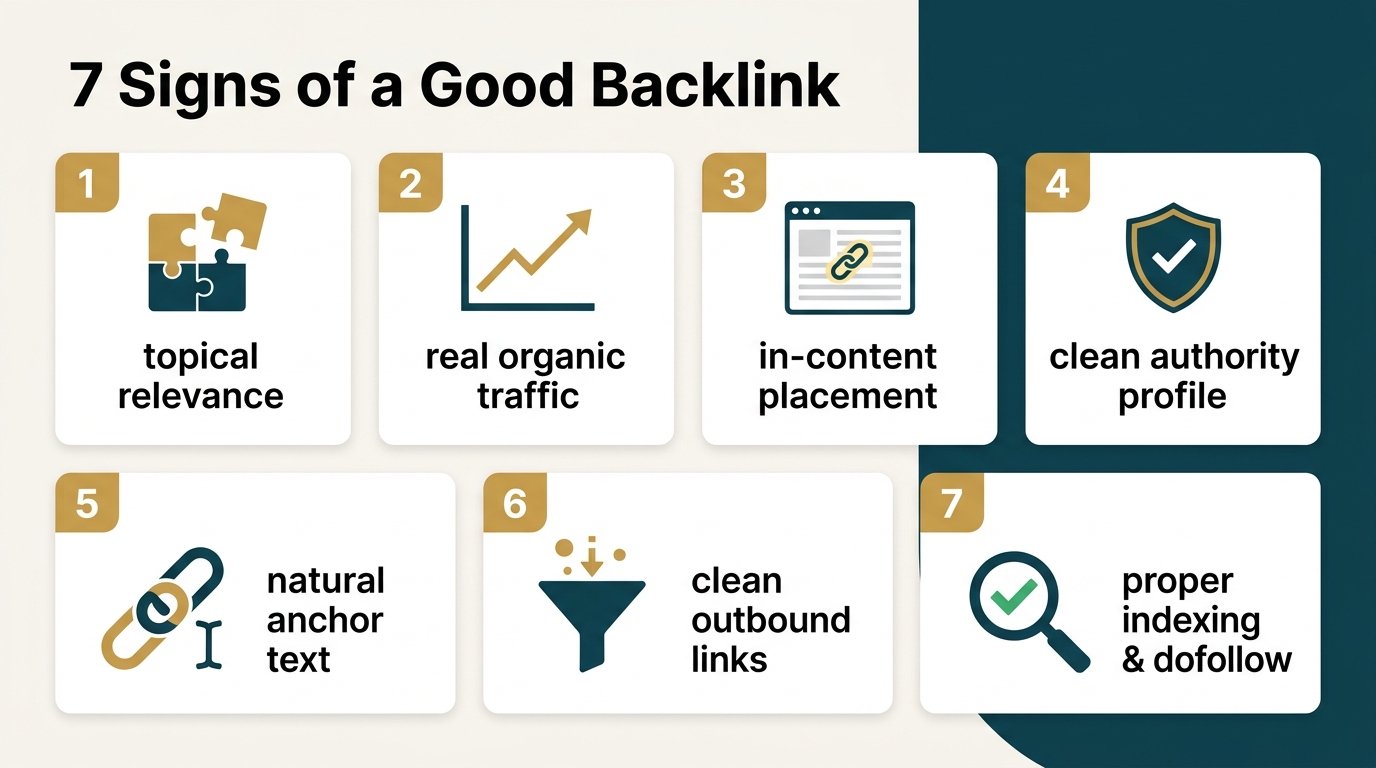


A good backlink is a link from a relevant, real website, placed naturally inside useful content, that points to the right page on your site and is labeled honestly. Seven signs tell you whether a link meets that standard: relevance, a real audience, editorial placement, natural anchor text, honest labeling, a clean neighborhood and the right destination page.
This guide gives you each sign as a plain check, a quick score you can run in five minutes, and a free way to review the links you already have. If you are new to the topic, start with our beginner’s guide to link building first.
What makes a good backlink?
A backlink is a link from another website to yours. Search engines use links to discover pages and to understand which pages other sites find worth mentioning. A good backlink is one that a real editor would put on the page even if you had never asked, because it helps the reader.
That is the test behind every sign below. Google’s own spam policies describe link spam as links made to manipulate rankings, so the safest way to judge a link is to ask whether it would exist without SEO.
Tool scores such as Domain Rating or Domain Authority can help you compare sites, but they are third-party estimates. Google does not use them. Treat them as a rough hint, never as the verdict.
The 7 signs of a good backlink
1. The page is relevant to yours
The linking page should cover a topic close to what your page covers. A bakery linked from a local food blog makes sense. The same bakery linked from a page about car insurance does not.
Check two things: the topic of the whole site, and the topic of the specific page that holds your link. A relevant page on a general site beats an unrelated page on a famous one.
2. A real site with real readers
Open the site and look at it the way a visitor would. You want a clear purpose, original articles, an author or team you can identify, recent posts and some sign of an audience, such as comments, shares or a newsletter.
We cover this site-level check in detail in our guides to checking a site’s real traffic and checking guest post site quality. A site that fails those checks rarely gives a good link, however good the page looks.
3. An editorial placement in the body
The best links sit inside the main text of an article, in a sentence that needs the reference. Links in footers, sidebars, author bios on thin pages or long lists of “resources” are weaker and more likely to look manufactured.
Ask yourself: if I removed the link, would the sentence still make sense and would the reader lose something? If the answer is yes, the placement is editorial.
4. Natural, descriptive anchor text
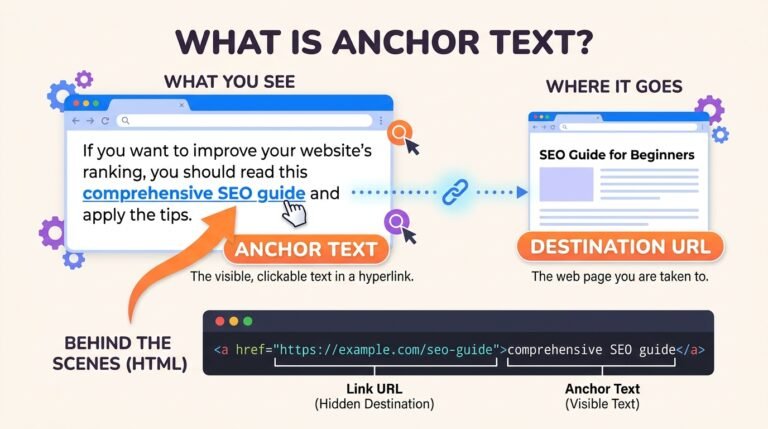
Anchor text is the clickable words. Good anchors describe what the reader will find, such as your brand name, your page’s topic or a plain URL. Repeating the same exact-match keyword across many links looks forced.
A healthy profile has mostly brand and descriptive anchors with a few partial or exact matches that happened naturally. Our types of backlinks guide shows how anchors and labels fit together.
5. The link is labeled honestly
Google asks that paid links and advertising links be marked with rel="sponsored" (or nofollow), and that user-generated links be marked ugc or nofollow. You can read the details in Google’s guide to qualifying outbound links.
Honest labeling is a sign of a healthy source. A paid link that is hidden as a normal link is a risk for both the site and you. “Dofollow” is not an official Google term; it simply means a link without those labels.
6. A clean neighborhood
Look at what else the page links to. A good page links to a small number of useful sources. A page that links to casino sites, supplement sellers, payday loans and unrelated businesses in the same article is a bad neighborhood.
Also scan the site for signs of a link farm: dozens of “write for us” pages, articles on random topics, obvious pricing for links, or the same author photo across unrelated niches.
7. It points to the right page
A link is only as useful as the page it sends people to. A good link points to the page that answers the reader’s question, such as a guide, a service page or a data page, not always your homepage.
Make sure the destination loads quickly, answers the question that led to the link and works on mobile. A great link to a broken or irrelevant page wastes the effort.
A quick 14-point score for any link
Use this table to score a link in about five minutes. Give each sign 0, 1 or 2 points. This is our own rule of thumb for deciding where to spend time, not a Google metric.
| Sign | 0 points | 1 point | 2 points |
|---|---|---|---|
| 1. Relevance | Unrelated topic | Loosely related | Same or closely related topic |
| 2. Real site and readers | Thin, no author, no audience signs | Some signs | Clear purpose, real authors, active readers |
| 3. Placement | Footer, sidebar or list | Author bio or end of article | Inside the main text |
| 4. Anchor text | Forced exact-match keyword | Generic (“click here”) | Brand or descriptive |
| 5. Labeling | Paid and unlabeled | Unclear | Labeled correctly, or clearly editorial |
| 6. Neighborhood | Spammy outbound links | Mixed | Small number of relevant links |
| 7. Destination | Irrelevant or broken | Homepage only | Best-fit page |
How to read the score
- 11 to 14: worth chasing or keeping.
- 7 to 10: acceptable if it is cheap and fast, but do not make it a priority.
- 0 to 6: skip it, or remove and disavow only if it is clearly manipulative and you cannot get it taken down.
What does not make a link good
- A high tool score on its own. A site with a big number can still be a link farm.
- A large number of links. A few relevant links beat hundreds of random ones.
- A famous site that is off-topic. Relevance matters more than the logo.
- Being “dofollow”. Follow status is a detail, not a quality mark. Many strong links are not labeled
nofollowand many are, and both can send real visitors. - A price tag. Paying does not make a link good, and paying for links that pass ranking credit goes against Google’s spam policies unless the link is labeled
sponsored.
Are nofollow and sponsored links good backlinks?
Yes, they can be. A nofollow or sponsored link from a relevant, respected site can send real readers, build your name and support the rest of your profile. Google treats these labels as hints, so you should not expect them to behave exactly like an unlabeled link, but they are a normal part of a natural link profile.
If you are paying for a placement, ask for the sponsored label. A page without it is a red flag. See our guide to free vs paid guest posting for how to think about this.
Worked example: a Tampa landscaping company
This is an illustration, not a real client. A landscaping company in Tampa is offered three links.
| Link offered | Relevance | Real site | Placement | Anchor | Label | Neighborhood | Destination | Score |
|---|---|---|---|---|---|---|---|---|
| Home and garden blog, mention in a lawn care guide | 2 | 2 | 2 | 2 | 2 | 2 | 2 | 14 |
| Local chamber of commerce member page | 1 | 2 | 1 | 2 | 2 | 2 | 1 | 11 |
| “Business directory” with 500 categories, footer link, exact-match anchor | 0 | 0 | 0 | 0 | 1 | 0 | 1 | 2 |
The first two are worth the effort. The third is a skip, even if the seller says it has a high authority score.
How to review the links you already have (free)
- Export your links. In Google Search Console, open Links and download the “Top linking sites” and the linked pages.
- Sort by surprise. Look for domains you do not recognize, unusual spikes or the same anchor repeated many times.
- Open the top 20. Visit the linking pages and score each with the table above.
- Fix before you disavow. If a link is paid and unlabeled, ask the site to add
sponsoredor remove it. Disavowing is a last resort for clear spam you cannot get removed. - Repeat quarterly. A small review every few months catches problems early.
If you also want to check on-site health first, our SEO audit checklist is a good start.
Which links to chase first
For a small business, start with links you can earn without a big budget: your suppliers, partners, local organizations, industry associations and customers who already mention you. Then add a few well-chosen guest posts on relevant blogs. Our link building plan for small businesses puts these in order.
If you would rather have an experienced team find and place links that pass the seven checks above, see our guest post service. We only pitch relevant sites and we label sponsored placements correctly.
Frequently asked questions
What is a good backlink?
A good backlink comes from a relevant, real website, sits naturally in the body of useful content, uses a descriptive anchor, is labeled honestly and points to the best page on your site.
Is a high Domain Authority backlink always good?
No. Domain Authority and Domain Rating are third-party scores, not Google metrics. A high number can still hide an off-topic or spammy site, so check relevance and real readers first.
How many backlinks do I need?
There is no fixed number. A few relevant links from real sites usually help more than many weak ones. Compare yourself to the pages that rank for your target keywords.
Are nofollow backlinks worth getting?
Yes, when the source is relevant and has real readers. They can bring visitors and build trust, even if they do not pass ranking credit in the same way.
What is a bad backlink?
A bad backlink is usually off-topic, from a thin or spammy site, bought without a sponsored label, or placed in a footer or link list with forced exact-match anchor text.
Should I disavow bad backlinks?
Only for clear manipulative links you cannot get removed. Most random low-quality links are ignored by Google, so disavowing is rarely needed.
The short version
A good backlink is relevant, comes from a real site, sits inside the content, uses a natural anchor, is labeled honestly, lives in a clean neighborhood and points to the right page. Score a link before you chase it, review your existing links a few times a year, and spend your effort where the score is high.
Want help earning links that pass these checks? Talk to NextGen Digital about a guest post plan for your business.
Related guides