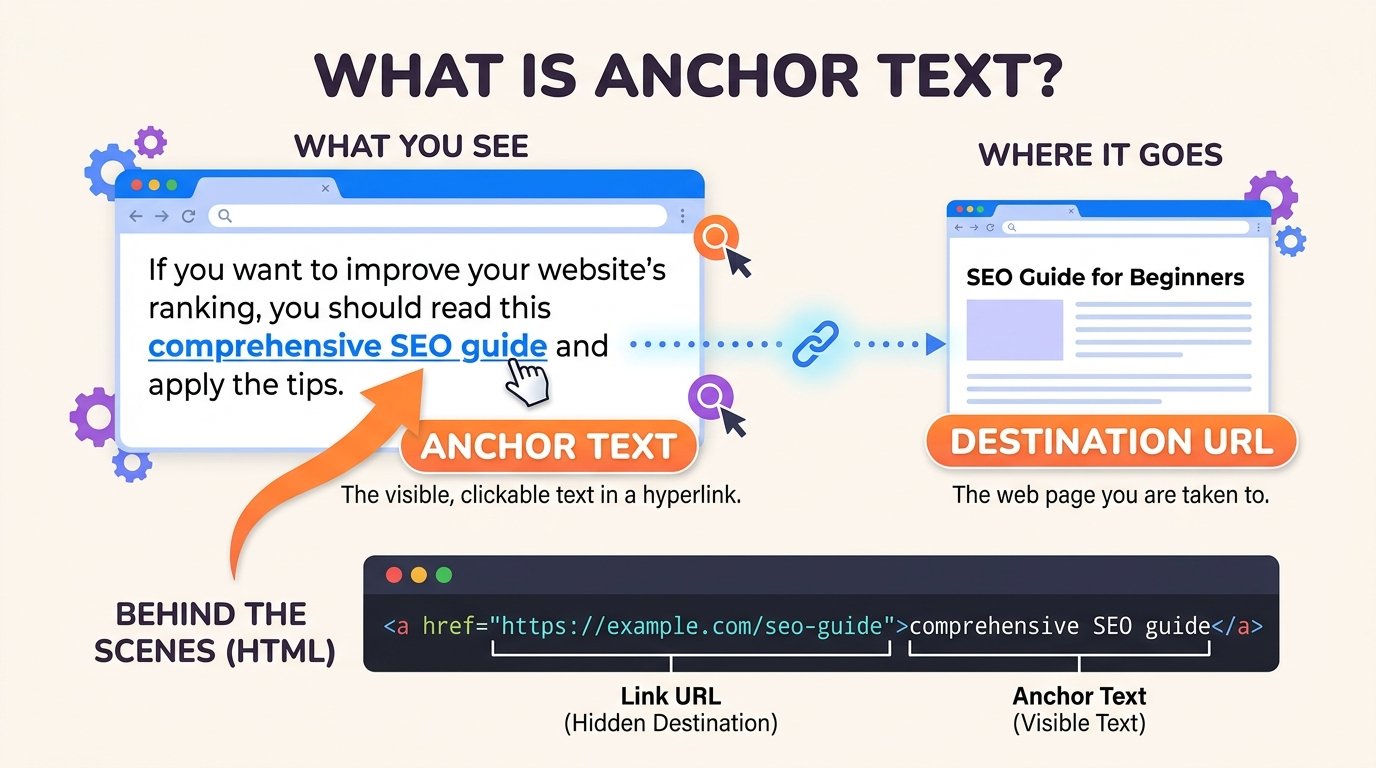


Anchor text is the clickable, visible words of a link. It tells readers and search engines what they will find on the other side, so clear, descriptive anchor text helps both people and Google understand the page you link to.
This guide explains the main types of anchor text, what Google says about it, and how to choose safe anchors for backlinks and for links inside your own site.
What is anchor text?
In HTML, the anchor text sits between the opening and closing link tags:
<a href="https://example.com/roof-repair/">roof repair guide</a>Here, “roof repair guide” is the anchor text. A reader sees those words underlined or highlighted, and clicking them opens the linked page. If the link is an image, Google uses the image’s alt text as the anchor text.
Why anchor text matters for SEO
Google’s link best practices say good anchor text is descriptive, reasonably short and relevant to the page it points to and the page it sits on. It helps Google understand what the linked page is about, and it helps readers decide whether to click.
That is also why anchor text is easy to abuse. Google’s spam policies list keyword-optimized anchor text in articles, guest posts or press releases on other sites as an example of link spam. The goal is anchors that read naturally, not anchors stuffed with the keyword you want to rank for.
The 7 types of anchor text
| Type | What it looks like | Example for a roofing company |
|---|---|---|
| Branded | Your business name | Example Roofing Co. |
| Naked URL | The web address itself | exampleroofing.com |
| Descriptive | A phrase that explains the page | a guide to spotting hail damage on your roof |
| Partial match | Contains part of the target keyword with other words | tips for roof repair after a storm |
| Exact match | Exactly the keyword the page targets | roof repair Denver |
| Generic | Non-descriptive words | click here, read more, this page |
| Image | A linked image; the alt text acts as the anchor | Alt text: “Hail damage on asphalt shingles” |
None of these types is banned. The risk comes from the mix, and from exact-match anchors used again and again in links you place yourself.
What Google says about anchor text
Google’s link best practices boil down to four points:
- Describe the destination. A reader should know what they will get before they click.
- Keep it reasonably short. A few words, not a whole sentence.
- Avoid generic words. “Click here” tells neither people nor Google much.
- Do not stuff keywords. Packing in keywords the reader does not need breaks Google’s spam policies.
For links in guest posts and other content you place on someone else’s site, Google’s spam policies specifically warn against keyword-optimized anchor text. If you pay for a placement, the link should also be labeled sponsored or nofollow. Our guide to types of backlinks explains those labels.
Anchors you control, suggest and earn
Not all anchor text is in your hands, and the rules change with how much control you have.
| Situation | Who picks the anchor | What to do |
|---|---|---|
| Internal links on your own site | You | Use clear, descriptive anchors. Exact match is fine when it reads naturally |
| Guest posts and link insertions | You suggest, the editor approves | Prefer brand, URL or descriptive anchors. Avoid exact match |
| Earned links (mentions, press, citations) | The other site | Let them choose. Do not ask them to change a natural anchor into a keyword |
The more control you have over a link on another site, the more natural your anchor should look.
A safe anchor text mix for backlinks
Google does not publish an ideal ratio. We use the planning guideline below for links we place, and it matches the one in our guest posting outreach guide. It is our own rule of thumb, not a Google rule.
| Anchor type | Share of placed links | Example |
|---|---|---|
| Brand or URL | About half | Example Roofing Co., exampleroofing.com |
| Partial match | About a third | tips for roof repair after a storm |
| Descriptive | The rest | a guide to spotting hail damage |
| Exact match | Rarely, under 5% | roof repair Denver |
The point is variety across your whole profile, not a fixed split for every post. If you would rather have someone plan anchors and placements for you, our guest post service handles both.
Good vs bad anchor text: a Denver roofing company
This is an illustration, not a real client. A roofing company in Denver is placing three guest posts and adding internal links.
| Where | Bad anchor | Better anchor | Why |
|---|---|---|---|
| Guest post on a home blog | roof repair Denver | Example Roofing Co. | Brand anchor in a placed link looks natural |
| Guest post on a local news site | best roofer Denver cheap | a guide to spotting hail damage | Descriptive and helpful to the reader |
| Press release | roof repair Denver, Denver roofer, roof replacement Denver | one link to exampleroofing.com | Several keyword anchors in one release is the pattern Google warns about |
| Internal link from a blog post | click here | our roof repair service | Describes the page; fine on your own site |
Anchor text for internal links
Internal links are the links between pages on your own site. You control them fully, so use them well:
- Link important pages from at least one other page, as Google’s link best practices recommend.
- Use anchors that describe the destination, such as “our roof repair service” rather than “learn more”.
- Vary anchors naturally. You do not need the same words every time.
- Avoid placing several links right next to each other; a few words between them helps readers tell them apart.
How to audit your anchor text for free
- In Google Search Console, open Links and look at Top linking text. It lists the most common anchors pointing to your site. Our guide on how to check your backlinks for free shows each step.
- Group the anchors into brand, URL, descriptive, partial and exact match.
- Look for one keyword phrase repeated across many sites. That is the pattern to stop.
- For links you placed, ask editors to change keyword-stuffed anchors to your brand or a descriptive phrase.
- Ignore odd anchors on random spam sites you did not create.
To judge the links themselves, use the checks in what makes a good backlink.
Frequently asked questions
What is anchor text in simple words?
Anchor text is the clickable words in a link. For example, in “read our roof repair guide”, the words “roof repair guide” could be the anchor text.
What is an example of anchor text?
In a link written as <a href="https://example.com">Example Company</a>, the anchor text is “Example Company”. That is a branded anchor.
Is exact match anchor text bad?
Not always. It is fine in internal links when it reads naturally. In guest posts and other placed links, repeated exact-match anchors are the pattern Google’s spam policies warn about, so use them rarely.
How long should anchor text be?
Short enough to read easily and long enough to describe the page. A few words is usually right.
What is the best anchor text for backlinks?
Your brand name, your URL or a descriptive phrase. These read naturally and tell the reader what they will find.
Does anchor text matter for internal links?
Yes. Descriptive internal anchors help readers and help Google understand your pages. You control them, so make them clear.
The short version
Anchor text is the clickable words of a link. Keep it descriptive and short, use your brand and URL for most links you place, keep exact-match anchors rare on other sites, and let earned links use whatever words the other site chooses.
Want guest posts with natural anchors on relevant sites? Talk to NextGen Digital.
Related guides