

Search intent is the goal behind a search: what the person actually wants when they type a query into Google. It matters for SEO because Google ranks the pages that best satisfy that goal, so a page built for the wrong intent rarely ranks, no matter how well it’s written.
If you’ve ever wondered why a thin directory listing outranks your detailed guide, intent is usually the answer. This guide explains the types of search intent, how to spot it in two minutes, and how to fix a page that’s aimed at the wrong one.
What search intent means
Every search has a job behind it. Someone typing “teeth whitening” might want to learn how it works, compare kits, book an appointment, or find a specific dentist’s website. The words are the same; the goal is not.
Search intent (also called user intent or keyword intent) is that goal. Keywords tell you what people type. Intent tells you what they need when the results load.
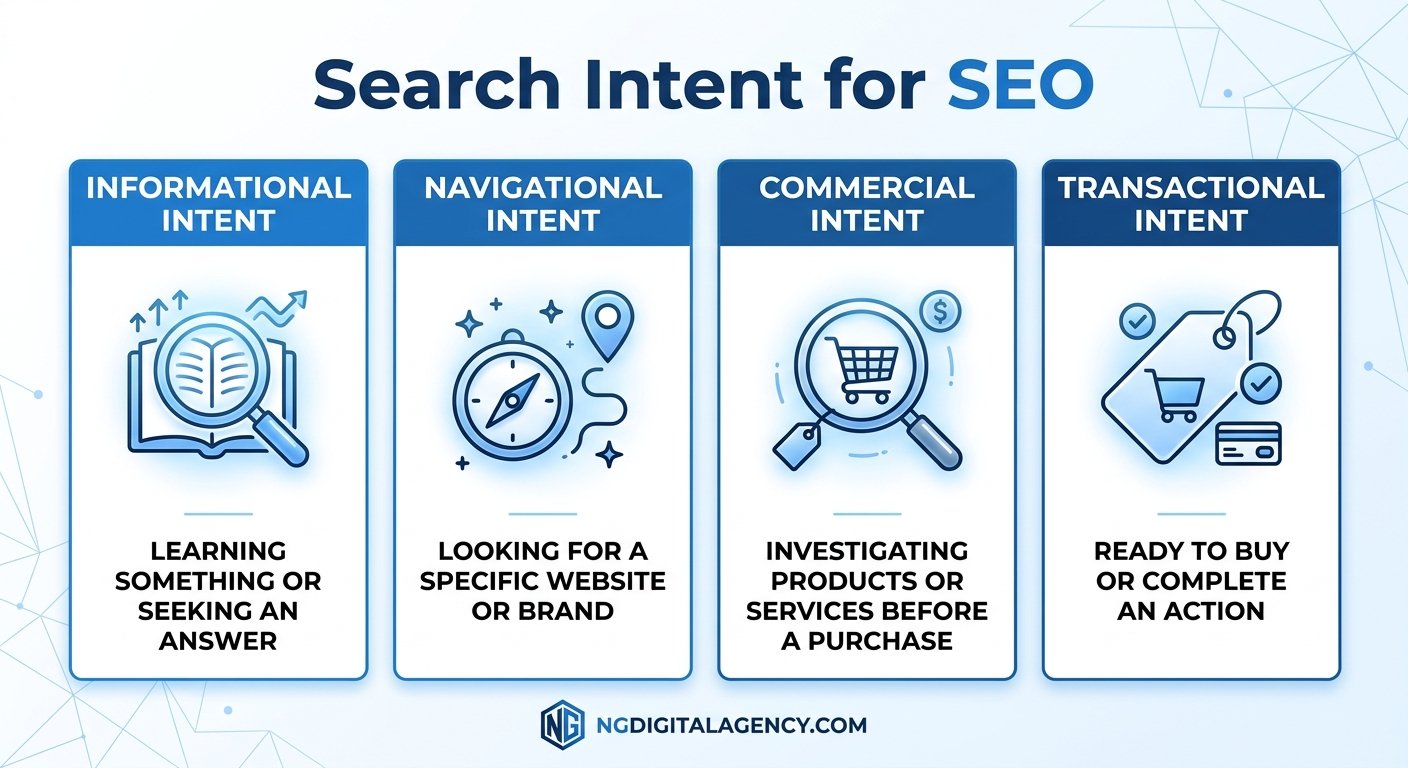
The 4 types of search intent
Most SEO tools and guides sort intent into four groups.
| Intent | What the searcher wants | Example search | Page that usually ranks |
|---|---|---|---|
| Informational | To learn or get an answer | how long does teeth whitening last | Guide, how-to, FAQ |
| Commercial investigation | To compare before deciding | Invisalign vs braces cost | Comparison, review, buying guide |
| Transactional | To act: buy, book, call, sign up | book teeth cleaning Austin | Service or product page with a clear next step |
| Navigational | To reach a specific site or page | Bright Smile Dental patient portal | That brand’s own page |
These labels are a simplification. Google’s own Search Quality Rater Guidelines (September 2025 edition) use different categories: Know, Do, Website and Visit-in-Person. The ideas overlap; the point is the same. Figure out what the person needs, then give them exactly that.
Mixed intent
Some searches serve several goals at once. “Dental implants” could mean “what are they”, “how much do they cost” or “who does them near me”. When the results page shows a mix of guides, service pages and a map, the query has mixed intent. You can still rank, but your page needs to cover the dominant need first.
Local intent
For service businesses, the most valuable intent is local. Searches like “emergency dentist” or “dentist open Saturday” often show a map pack first, even without a city name, because Google reads location as part of the query. These searchers want a nearby business they can call or visit today.
Why search intent is important for SEO
Google says it starts by working out what you mean before it looks for matching pages. Its explanation of how results are ranked puts meaning first, then relevance, quality, usability and context. (We break that process down in how SEO works.)
That has practical consequences:
- It decides which page type can rank. If Google shows service pages for a query, your blog post is competing in the wrong category.
- It shapes what “good content” means. A 2,500-word guide is great for an informational search and frustrating for someone who wants a phone number.
- It affects whether visitors stay and convert. Matching intent brings the right visitors, not just more of them.
- It lines up with Google’s guidance on helpful content. Google’s people-first content guidelines ask whether readers leave having learned enough to reach their goal, and flag content that sends people back to search again.
In short, matching intent is the price of entry. Links, speed and good writing only help once the page is the right kind of answer.
How Google figures out intent
You don’t need to know Google’s systems in detail, but a few signals explain most of what you’ll see:
- Words in the query. “How”, “what” and “why” signal learning. “Best”, “vs” and “review” signal comparing. “Buy”, “price”, “book” and “near me” signal action.
- Synonyms and meaning. Google matches concepts, so “adjust” and “change” can return the same pages.
- Location. A search for a service often triggers local results automatically.
- Freshness. Searches about news, prices or events favor recent pages.
Google also uses human quality raters to test its results, but the rater guidelines say no single rating directly changes how a page ranks. They’re a window into what Google is aiming for, not a list of ranking factors.
How to identify search intent in 5 minutes
The most reliable intent tool is free: Google’s results page. Search your keyword in a private browser window and check:
- Page type. Are the top results blog posts, service pages, product pages, videos or directories?
- Format. Are they how-tos, lists, comparisons, calculators or price pages?
- Angle. What do they emphasize: cost, speed, “for beginners”, “near me”, a specific year?
- SERP features. A map pack signals local intent. “People also ask” signals questions to answer. Shopping ads signal buying intent.
- Consistency. If eight of ten results are the same type, intent is clear. If they’re split, it’s mixed.
Write down the dominant type and format before you write or edit anything. If you’re still choosing which keywords to target, our keyword research guide shows how to build that list first.
Example: fixing a dental clinic page that targets the wrong intent
Here’s an illustrative example.
A family dental clinic in Austin, Texas, wants to rank for “teeth whitening Austin”. It published a 1,800-word blog post called “The Complete History and Science of Teeth Whitening”. The post never reached page one.
The owner searches the keyword and sees a map pack, then local clinic service pages with prices, before-and-after photos and booking buttons. The searchers want a provider, not a history lesson.
| Element | Before | After |
|---|---|---|
| Page type | Blog post | Service page |
| Title | The Complete History and Science of Teeth Whitening | Teeth Whitening in Austin, TX: In-Office and Take-Home Options |
| Opening | Ancient whitening methods | Treatments offered, price range the clinic actually charges, “Book online” button |
| Content | Science and history | How each option works, how long results last, who it suits, real patient photos (with consent), FAQs |
| Next step | None | Booking form, phone number, address and map |
| The old post | Targeting the money keyword | Trimmed into a guide for “how long does teeth whitening last” and linked to the service page |
Nothing about the writing quality changed. The clinic simply gave each search the type of page searchers wanted, and gave each page one job.
How to match your content to search intent
- Match the page type first. Guide for informational, comparison for commercial, service or product page for transactional.
- Answer the main need at the top. Price searches want prices near the top. How-to searches want steps, not background.
- Cover the follow-up questions. Use “People also ask” to find what readers wonder next.
- Give one page one intent. Don’t try to make a single page educate, compare and sell at once.
- Make the next step obvious. Informational pages can link to the related service. Transactional pages need a clear call, form or button.
- Use the searcher’s words in your title and headings. Our on-page SEO guide covers how.
If you suspect several of your pages are aimed at the wrong intent, an SEO audit can review your main pages against what Google shows for each keyword and list the fixes in order of impact.
Common search intent mistakes
- Writing a blog post for a buying keyword. If the results are service pages, a blog post rarely breaks in.
- Guessing intent from the keyword alone. “Crown” could mean dental crowns or something else entirely. Check the results.
- Ignoring local intent. If a map shows up, your Google Business Profile and a location-specific service page matter more than another article.
- Forgetting that intent changes. Results can shift with seasons, news or new products. Recheck your key terms every few months.
- Stuffing keywords to compensate. Repeating a phrase doesn’t fix a mismatch, and keyword stuffing is against Google’s spam policies.
FAQs
What is search intent in simple words?
Search intent is the reason someone searches. It’s what they want to do or find, such as learn something, compare options, buy something or reach a specific website.
What are the 4 types of search intent?
The four common types are informational (learn), navigational (find a specific site), commercial investigation (compare before deciding) and transactional (buy, book or sign up). Some searches mix more than one.
Why is search intent important for SEO?
Google tries to show the pages that best meet what the searcher wants. If your page doesn’t match that goal, it’s unlikely to rank, even if it’s well written and has good links.
How do I find the search intent of a keyword?
Search the keyword on Google and look at the top results. The most common type of page and format, plus features like a map or “People also ask”, show you the intent Google expects.
Is search intent a ranking factor?
Intent isn’t a single score you can optimize. But Google says understanding the meaning of a query is the first step in ranking, so pages that match intent have a real advantage.
Can one page target multiple search intents?
A page can support a related secondary need, such as a service page with a short FAQ. But trying to fully serve informational and transactional searches on one page usually weakens both. Give each main intent its own page and link them together.
The short version
Search intent is what the searcher really wants. Check the results page before you write, build the type of page Google already rewards, and give each page one clear job.
When your pages match intent and answer searches well, links from relevant sites help them rank higher. See how our guest posts work on real, traffic-checked websites, with sponsored link marking available on every order.